EPR Next Vendor Portal
Designing a scalable compliance workflow for recyclers managing multi-category EPR waste streams.
Key Impact
Driving Measurable Outcomes
45 min → 8 min
Delivery creation time reduced significantly.
80% fewer tagging errors
Improved document classification accuracy.
70% less manual work
Delivery creation time reduced significantly.
90% user satisfaction
Improved document classification accuracy.
36 → 12 : Required Data
Delivery creation time reduced significantly.
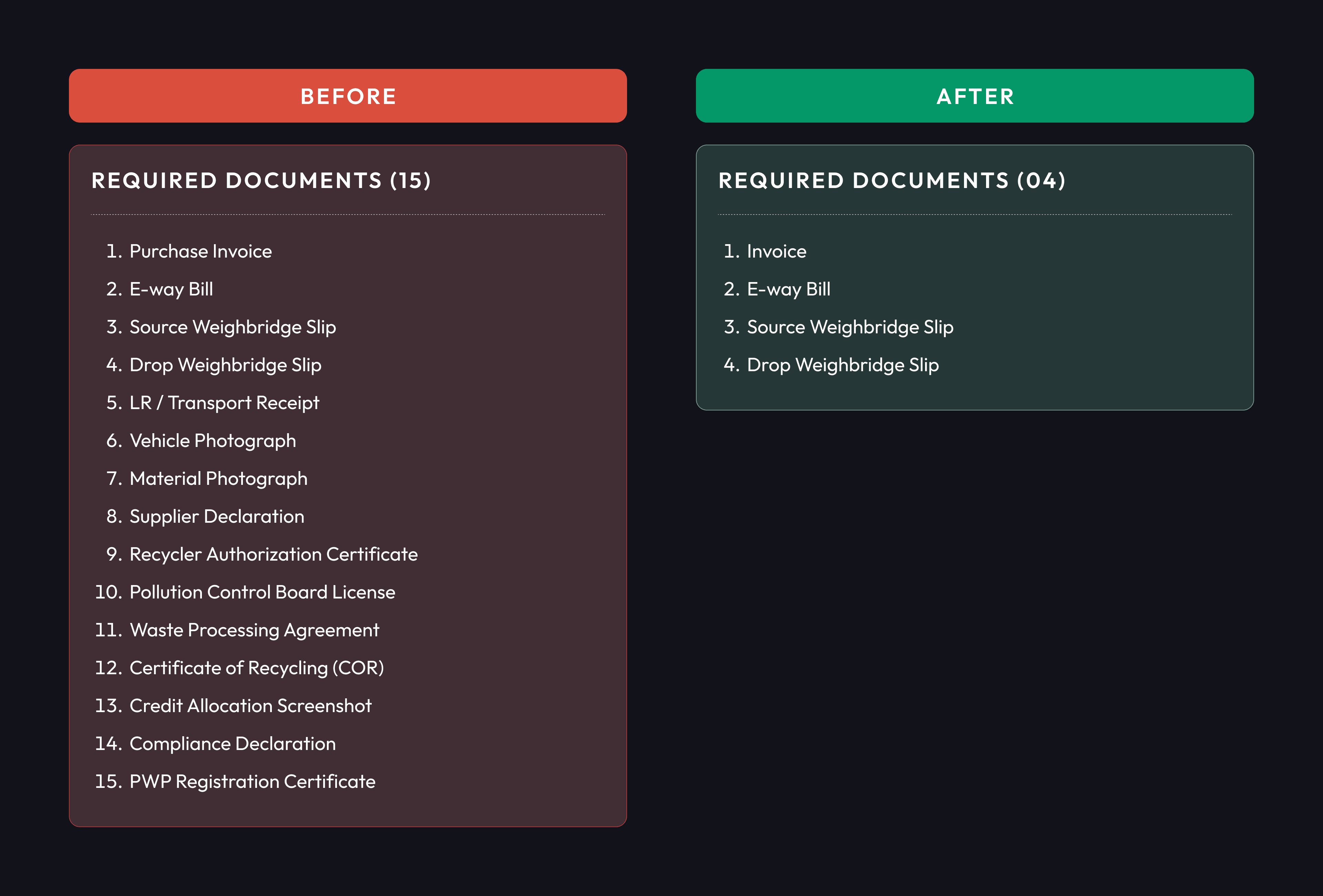
15 → 4 : Required Documents
Improved document classification accuracy.
Project Context
Understanding the EPR Ecosystem
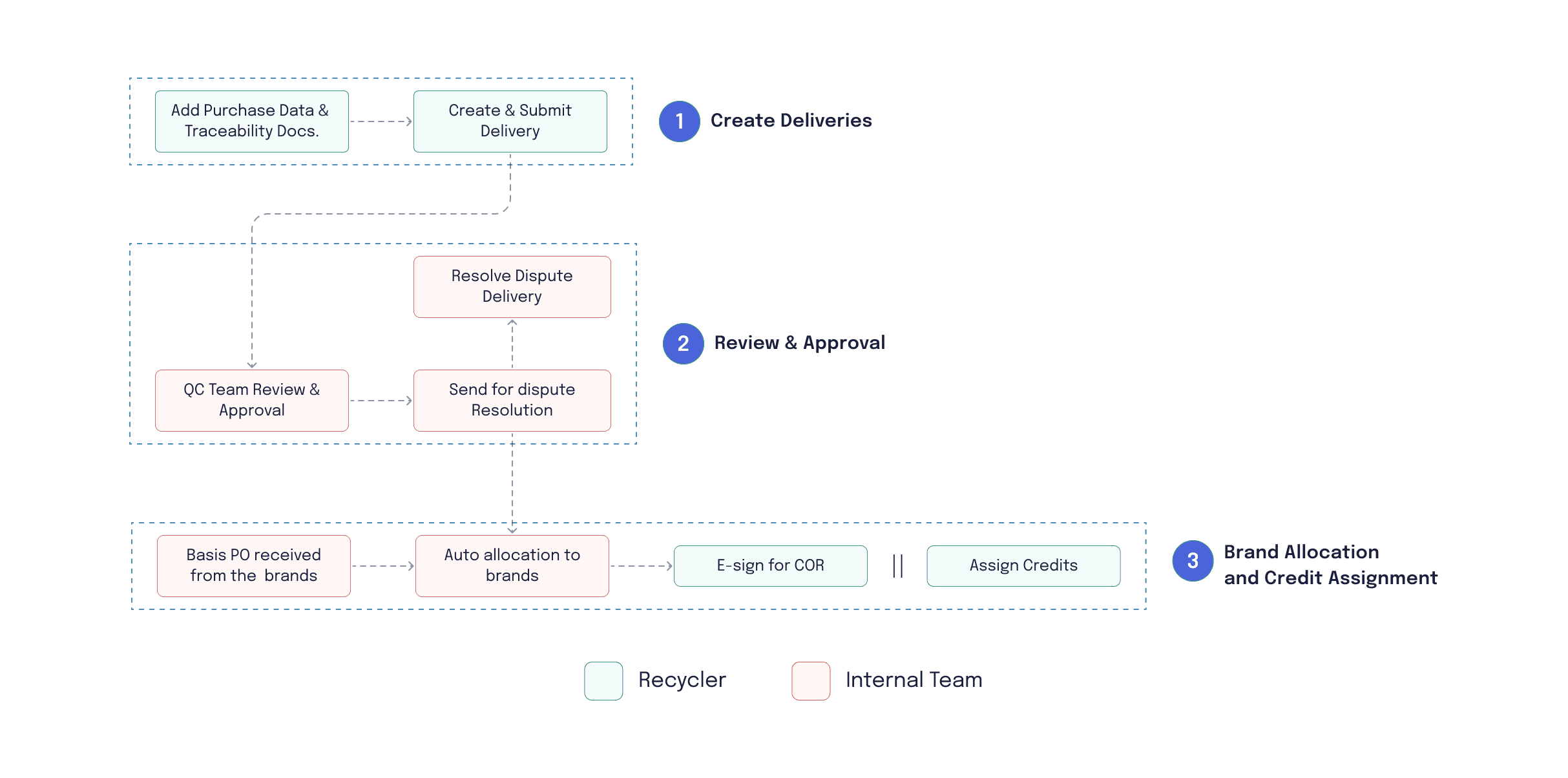
EPR Next is a platform that helps recyclers manage Extended Producer Responsibility (EPR) compliance across multiple waste categories.
The platform supports waste streams such as : Plastic • E-waste • Tyres • Metal
Recyclers use the platform to :
Record material deliveries
Upload traceability documents
Generate compliance credits for brands
EPR Compliance flow :
The Problem
Complex Requirements & Fragmented Data
Every truckload of recyclable material must be recorded as a delivery in the system.
Each Truckload = One Delivery
Creating a single delivery required recyclers to enter :
36+
Data Points
15+
Documents
Recyclers often handle thousands of deliveries every month, making this process extremely time-consuming.
Main Pain Points
Manual Data Errors
Frequent mistakes due to repetitive, manual data entry caused delays and frustration.
Too Many Requirements
36 data fields and 15 documents per delivery overwhelmed users and slowed processes.
Scattered Documents
Important files were shared via email or zip folders, making tracking hard.
Excel Already in Use
Recyclers were already tracking data in Excel, but the system didn’t support it.
No Demand-Fulfilment Visibility
Recyclers had no clear way to track how much demand had been completed or was pending.
No System Integration
No connection to e-way bill systems increased manual effort.
Research & Discovery
Uncovering Workflow Gaps
12+ User Interviews
Conducted 12 in-depth interviews with recyclers of varying scales to explore existing tools, methods, and pain points in compliance workflows.
Recycler Shadowing
Shadowed recyclers during actual operations to understand how they handle purchase orders, deliveries, and document management.
Data Analysis
Analyzed current workflows and tools (Tally, Excel, file-sharing apps) to identify inefficiencies and common error patterns.
Brainstorming session visuals :



Panic Solution
Quick Fixes That Didn’t Scale
Our first attempt focused on replacing manual communication with a portal-based workflow. Users could manually create deliveries and upload documents through the platform. However, this approach did not reduce the workload significantly.
Recyclers still had to :
Create deliveries individually
Upload documents one by one
Verify information manual
This helped us realize that simply digitizing the workflow was not enough.
The system needed to reduce the amount of manual work required.
Thoughtful Solution
Designing for Scale and Clarity
Instead of redesigning everything at once, we followed a two phase approach.
Solution - Phase 1
Simplify delivery creation and reduce manual work.
Solution - Phase 2
Introduce automation using OCR and integrations.
This approach allowed us to quickly improve usability while building a scalable system for the future.
Phase – 01
Simplifying Delivery Creation
Goal
Reduce the time and effort required to create deliveries while keeping the workflow familiar for recyclers.
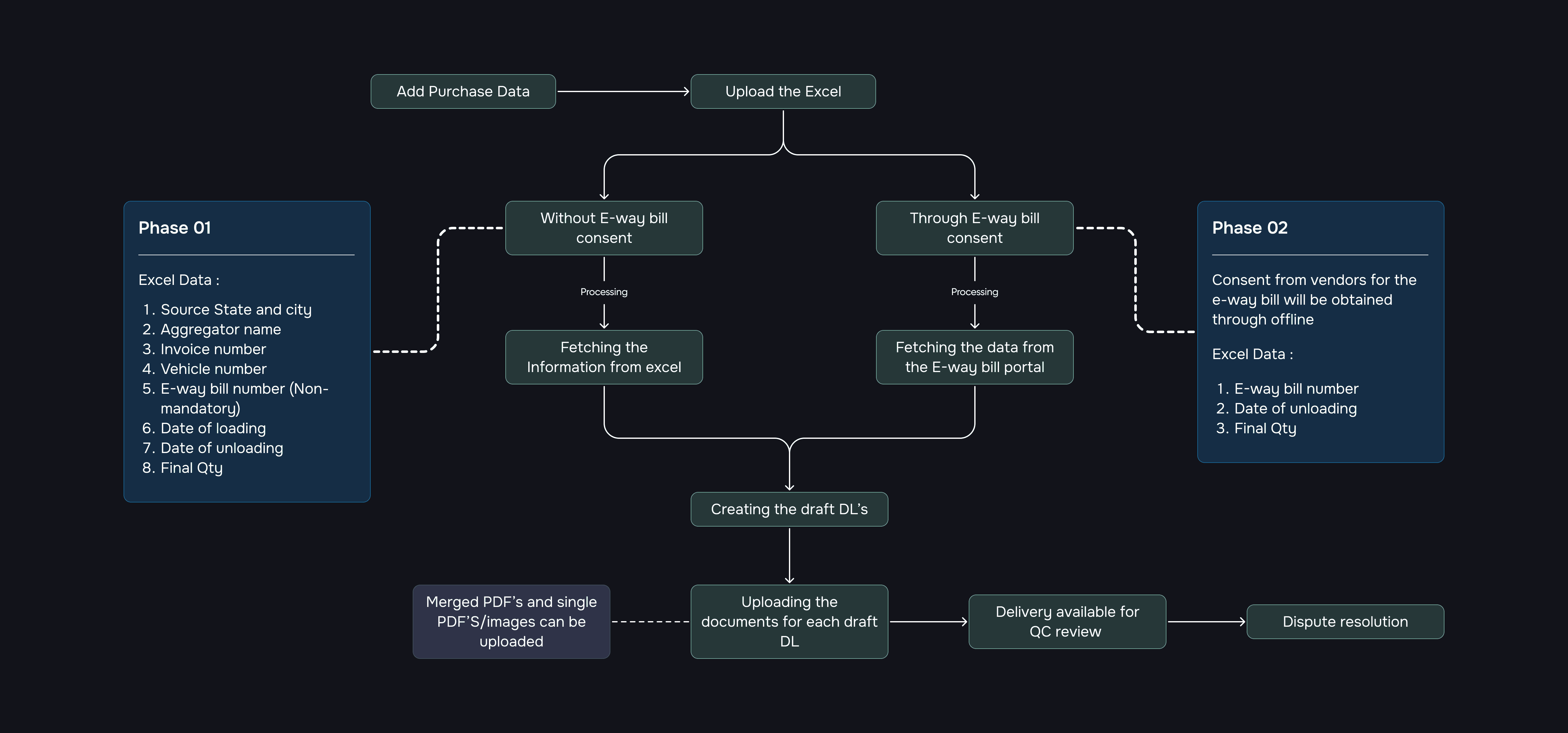
Bulk delivery creation through structured uploads
Recyclers upload structured purchase data instead of creating deliveries one by one.
Reduced data entry requirements
We reduced manual inputs from 36 data fields to 12 essential fields by removing redundant information and deriving data automatically.
Simplified document uploads
Document requirements were reduced from 15 documents to 4 essential uploads needed for traceability.
Phase – 02
Automation and Integrations
Goal
Improve accuracy, reduce manual verification, and build a system that can scale with growing demand.
E-way Bill Integration
Delivery details can be automatically fetched from government systems when users provide consent.This reduces manual entry of logistics data.
OCR Document Tagging
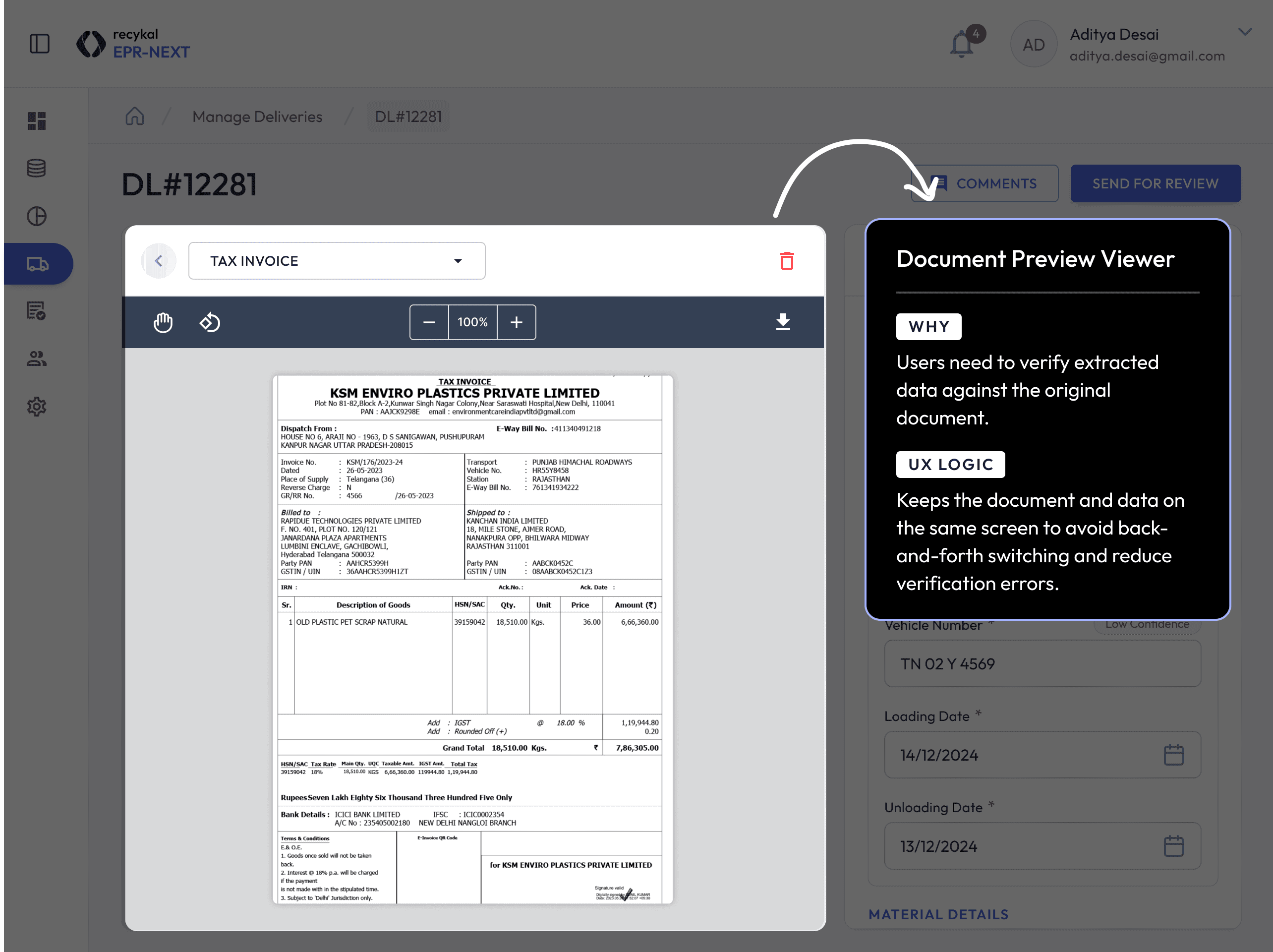
Uploaded documents are automatically analyzed and matched to the correct delivery.This reduces manual document tagging.
Operational Dashboard
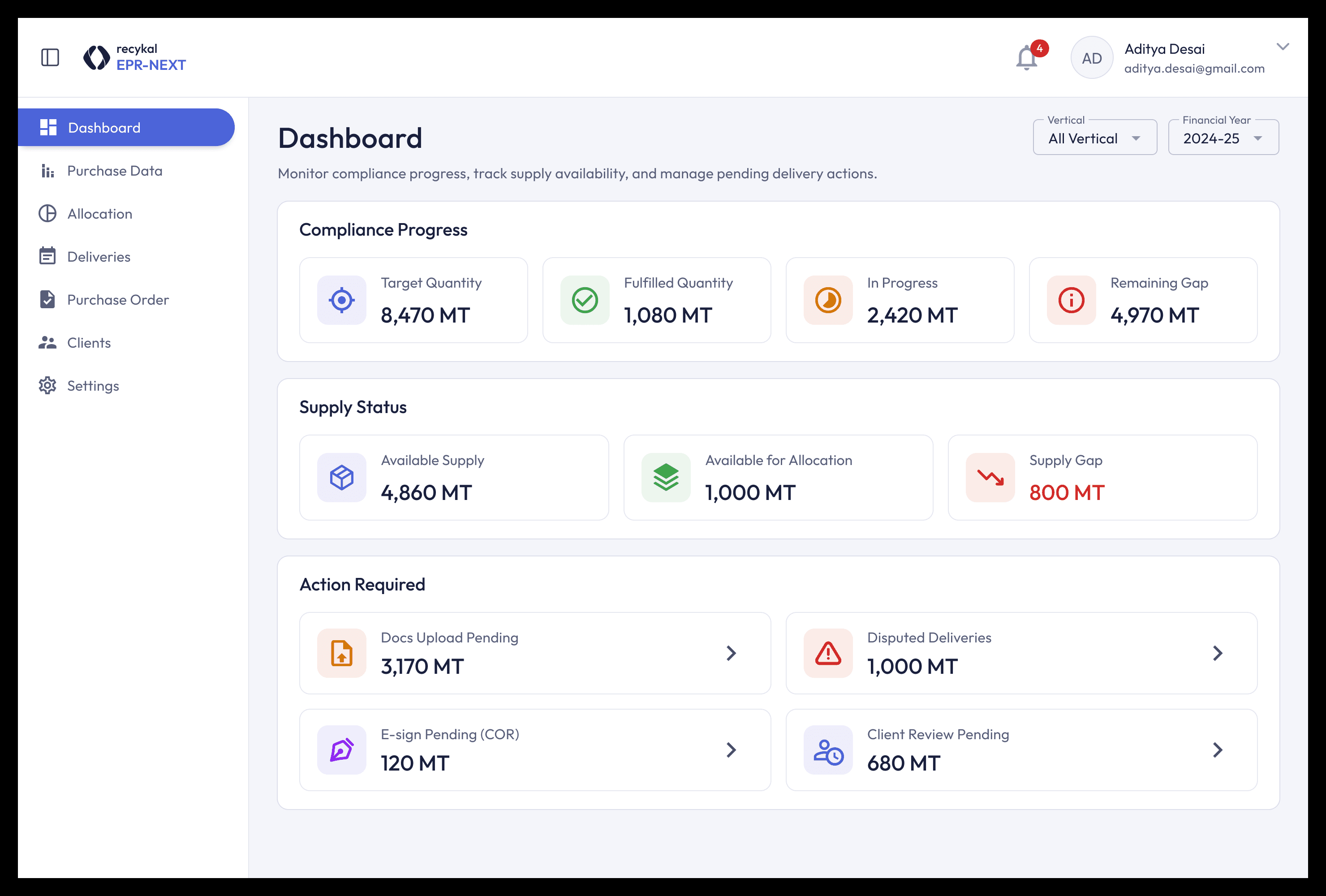
We introduced dashboards that provide visibility into delivery status, document completion, and compliance progress.
Design Breakdown
Decisions Behind the Experience
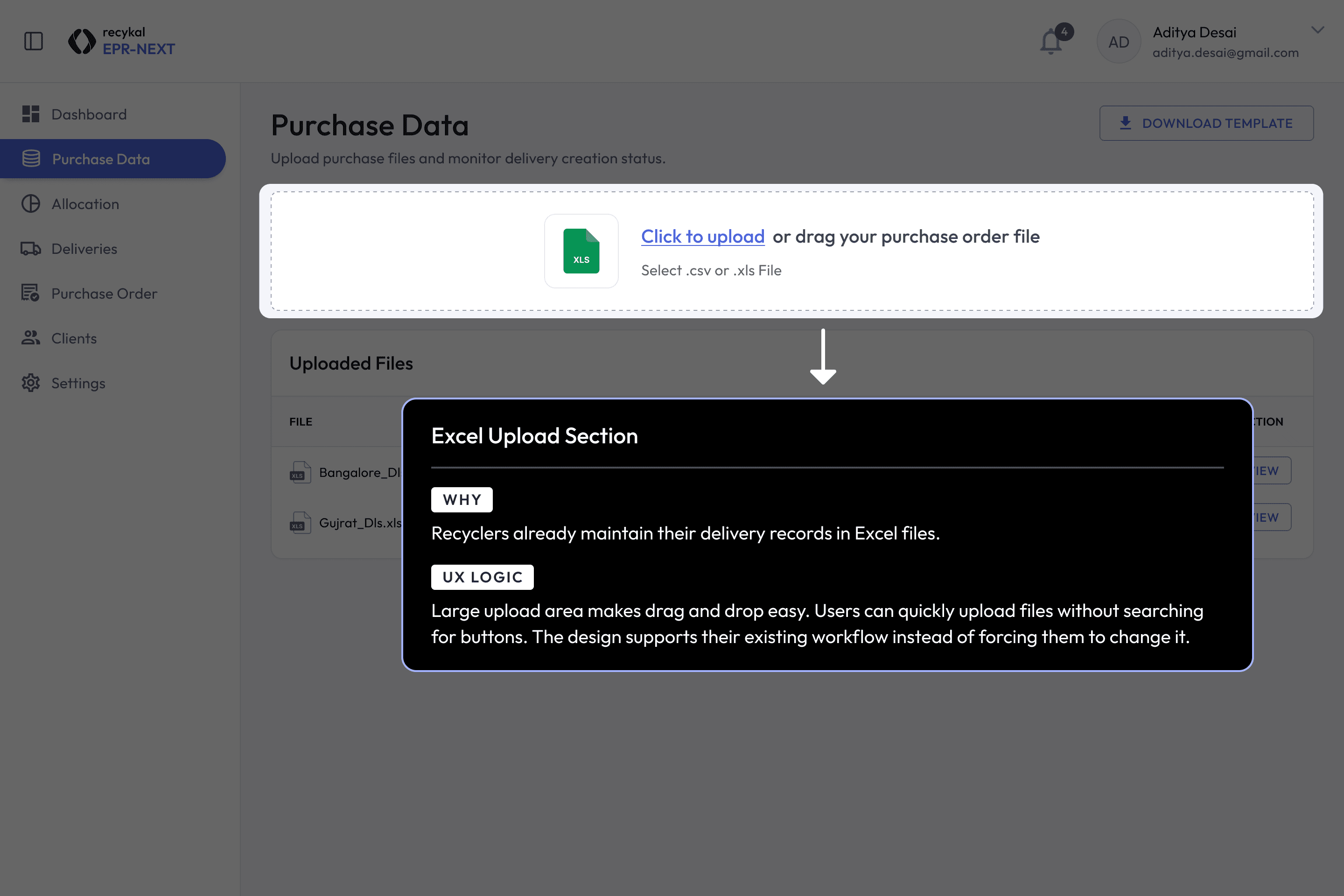
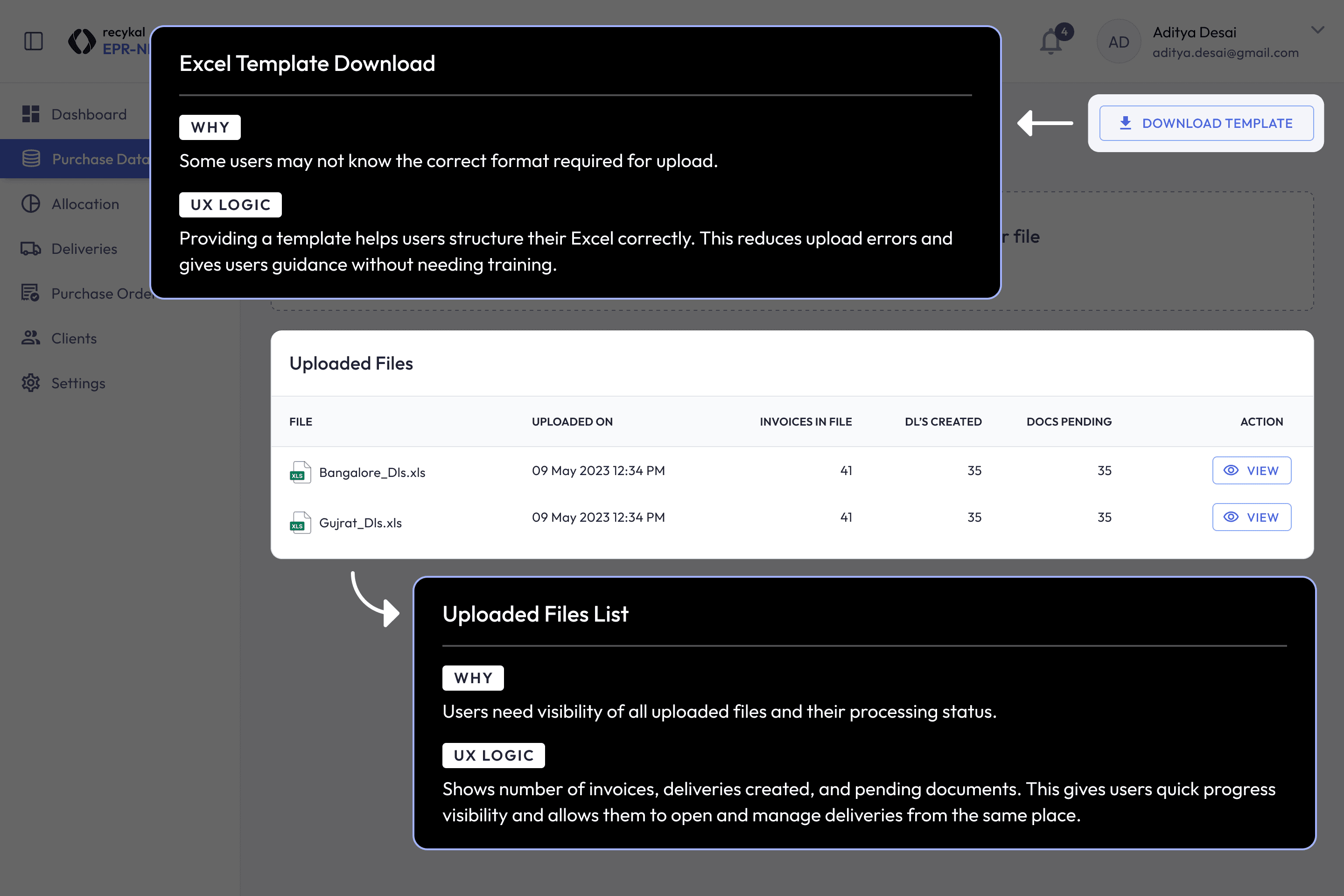
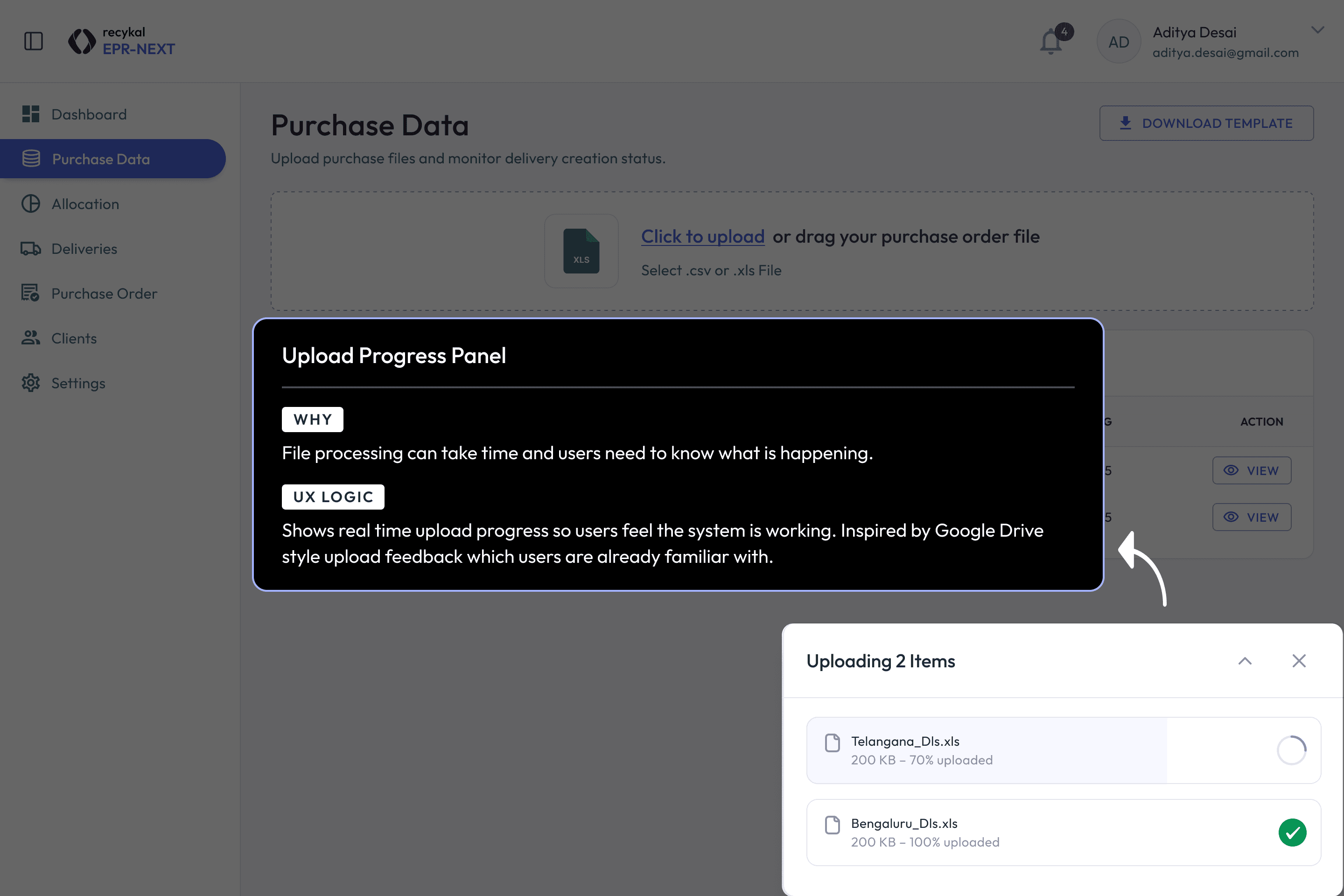
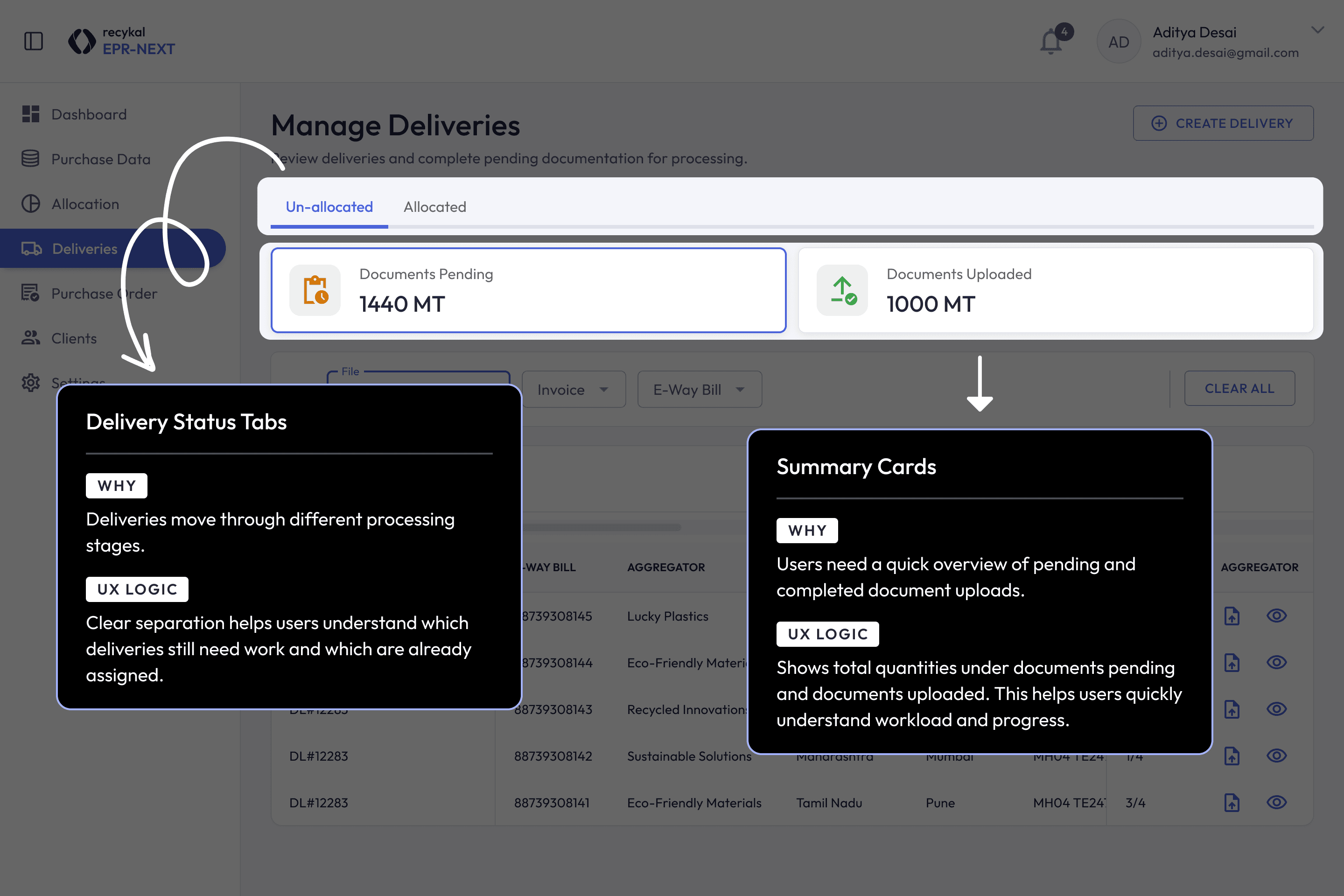
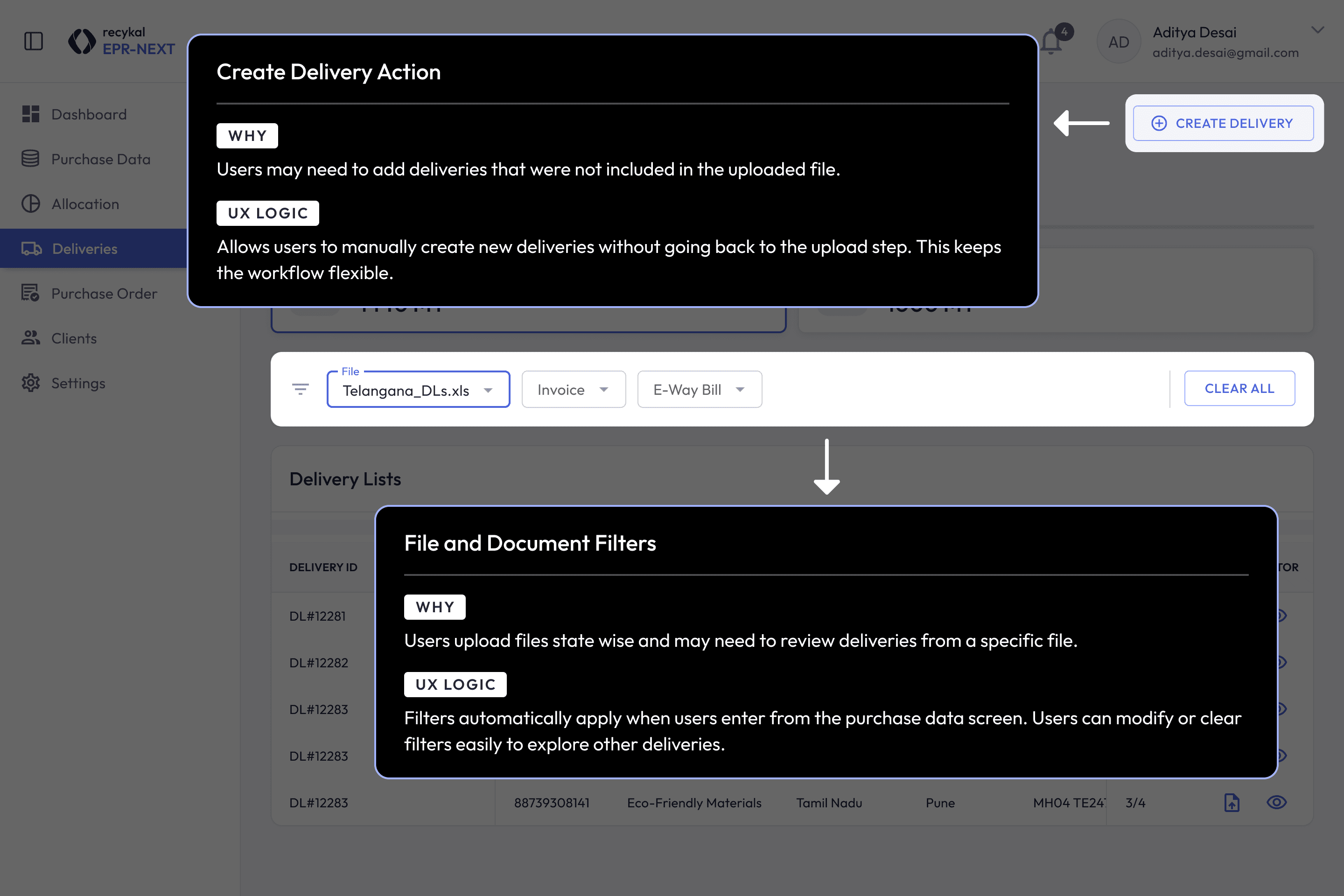
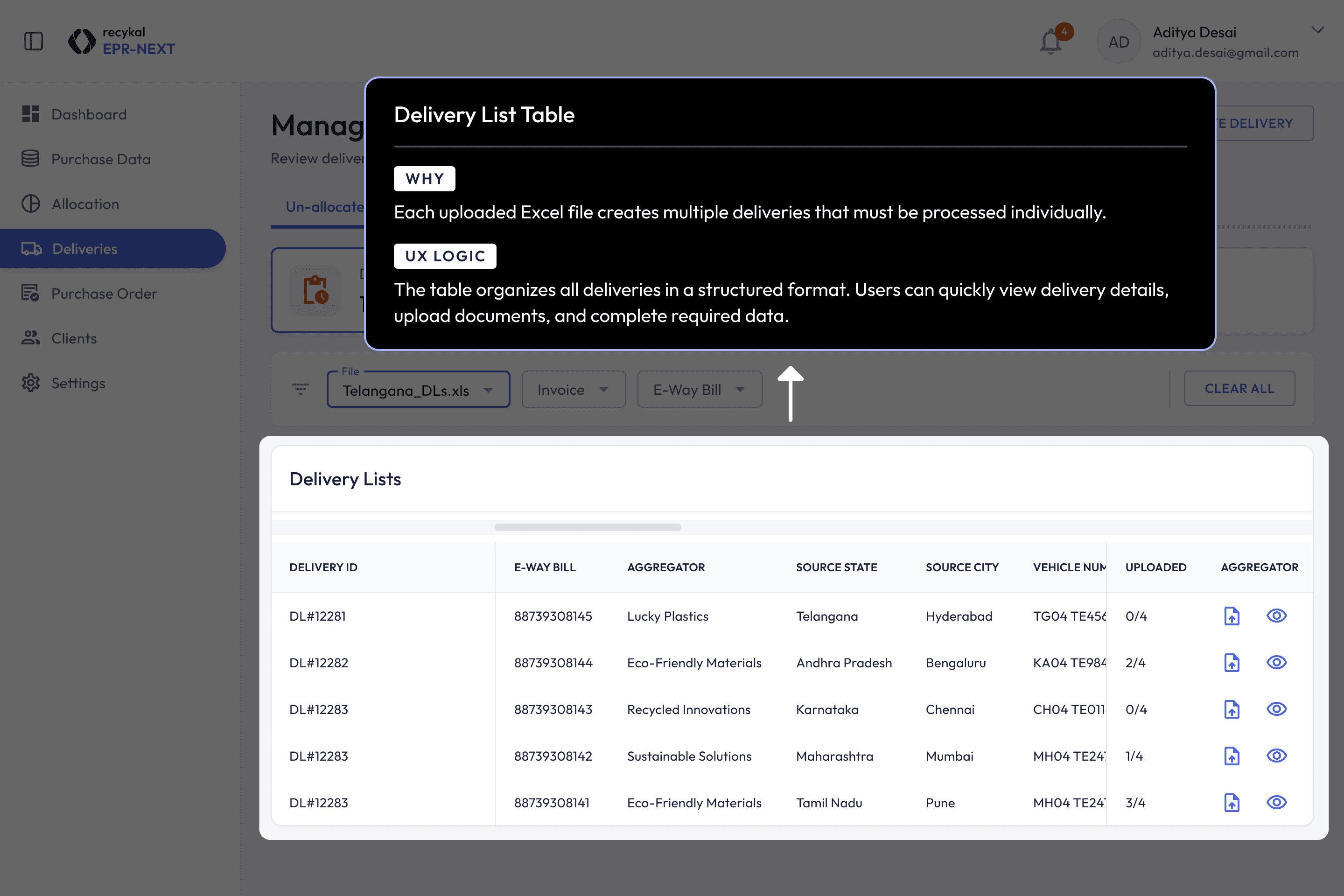
Bulk Delivery Creation Workflow
To reduce manual entry, we introduced Excel based delivery creation. Users can upload purchase files and automatically generate multiple deliveries.
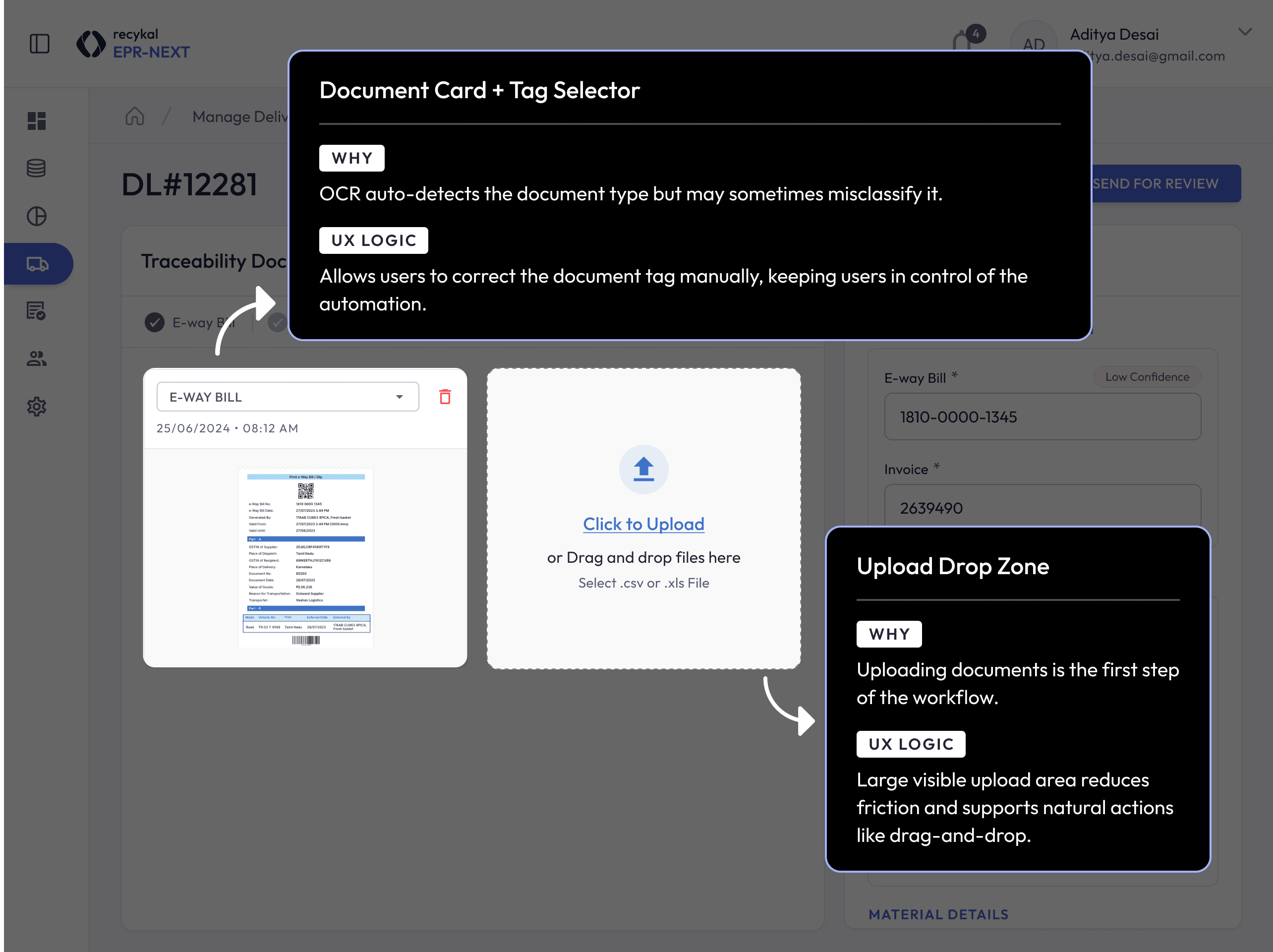
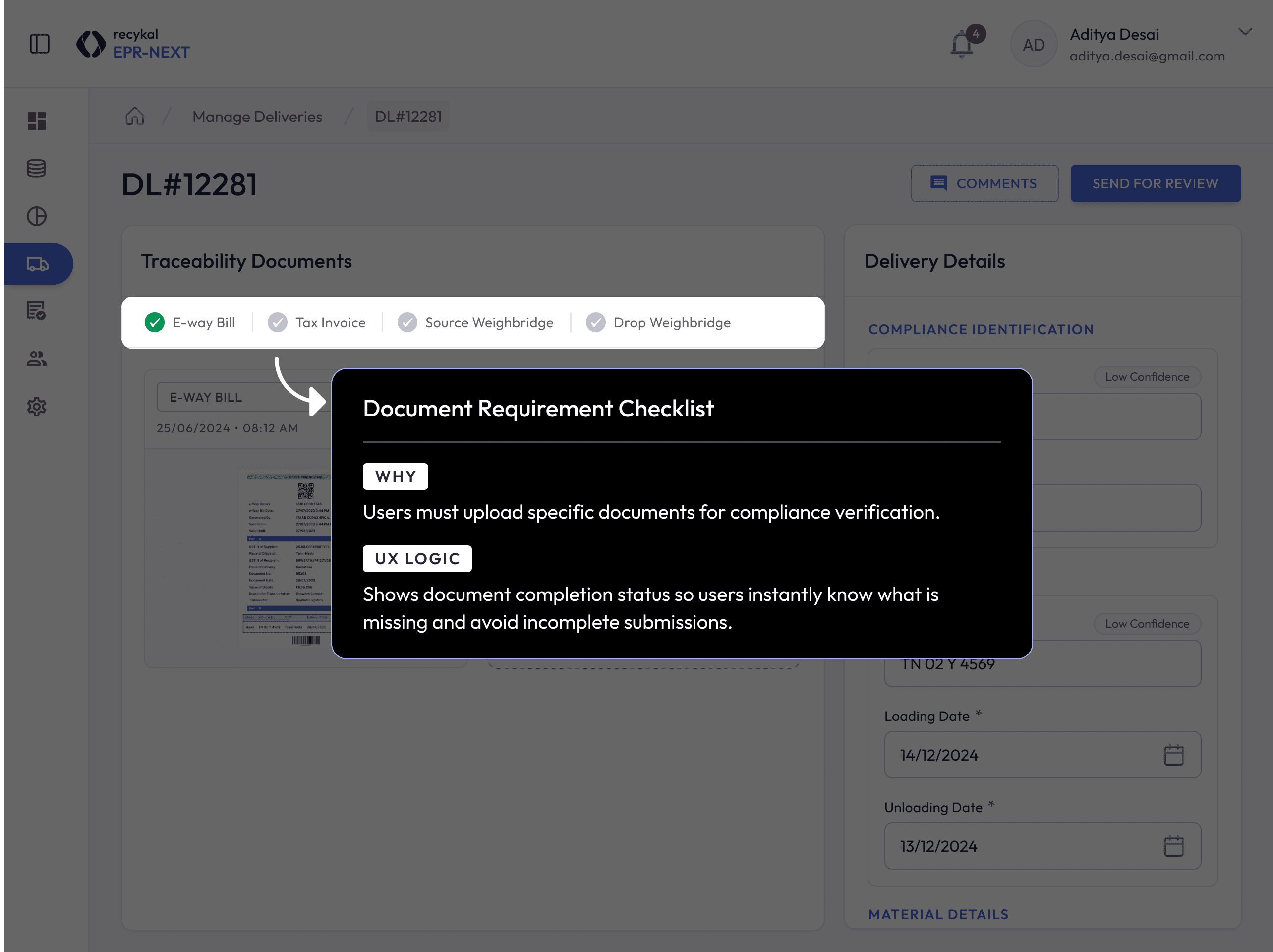
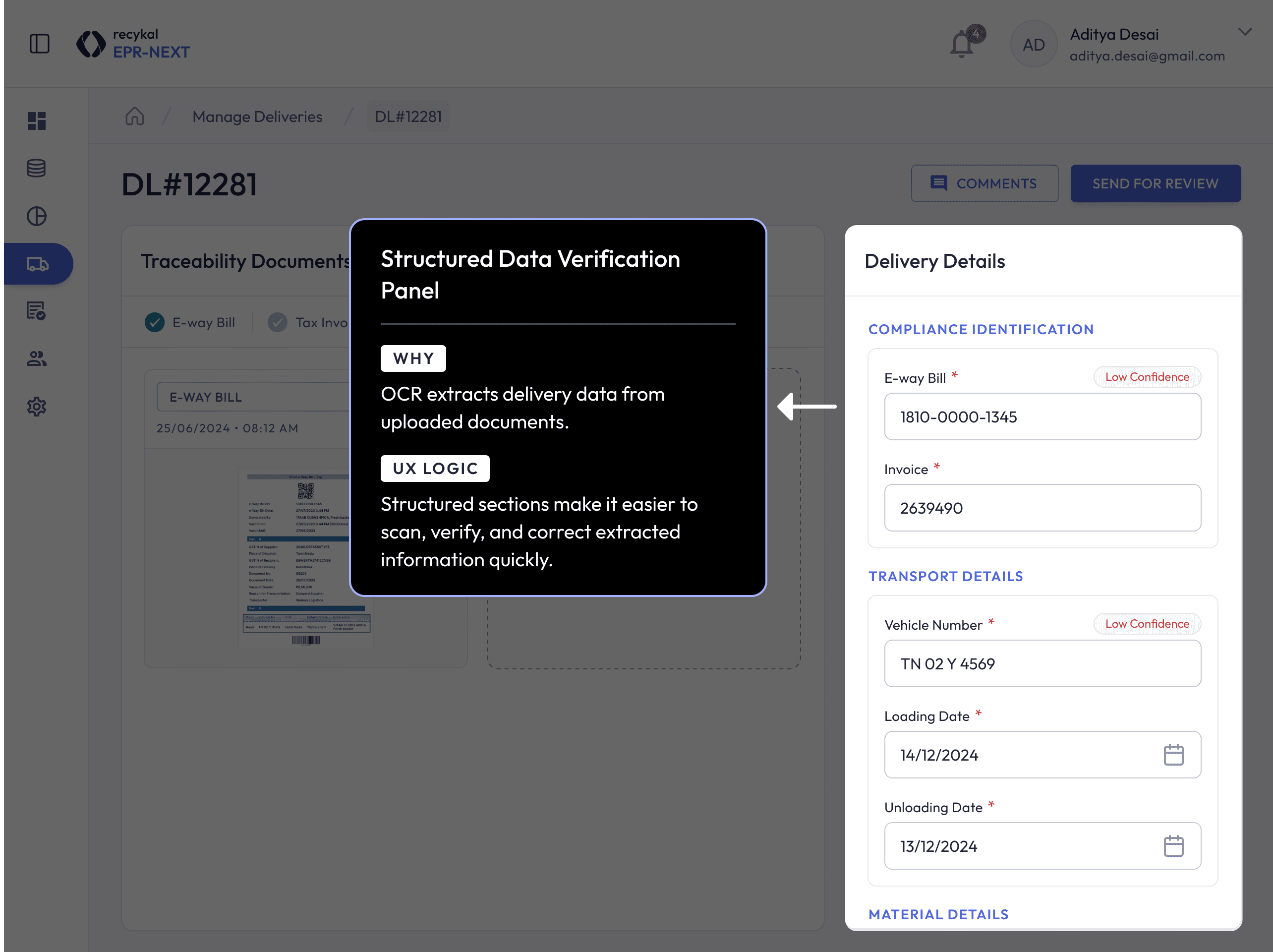
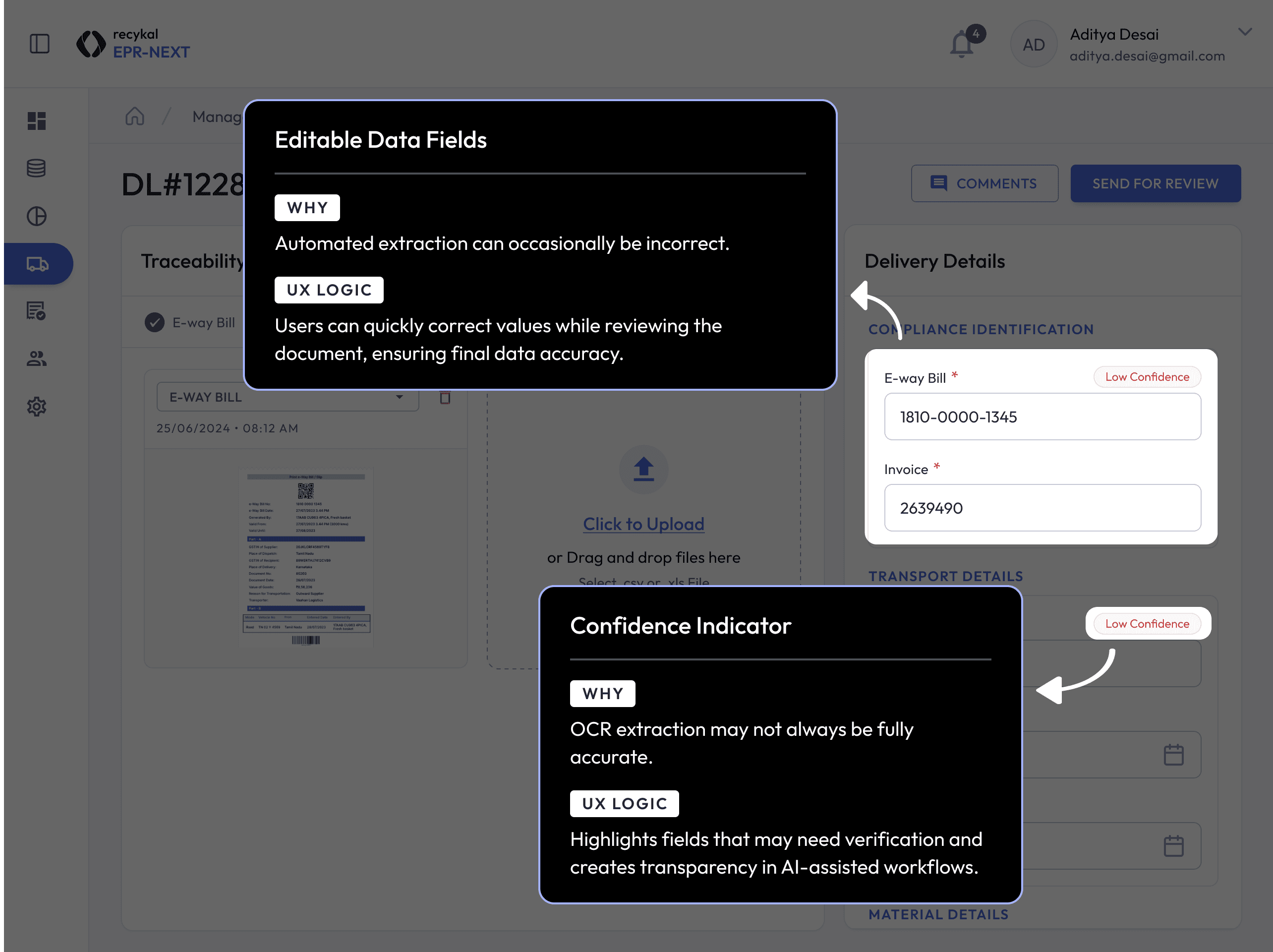
AI Assisted Document Processing
Once deliveries are created, users must upload supporting documents. To reduce manual work, the system uses OCR to automatically process documents.
Business Impact
Improving Efficiency and Trust
Operational Efficiency
Automation reduced manual processing time by 70%, allowing recyclers to focus on core business activities and scale operations.
Compliance Accuracy
50% reduction in submission errors improved regulatory compliance and strengthened relationships with brand partners.
User Satisfaction
90% user satisfaction score led to increased platform adoption and positive word-of-mouth referrals.
Business Relationships
Enhanced recycler experience strengthened partnerships and positioned Recykal as the preferred EPR compliance platform.
Challenges
Constraints and Trade-offs
Trust Barrier
Users initially hesitated to rely on automated document processing.
Complex Compliance Requirements
Different materials and regulations created workflow complexity.
Diverse User Base
Users had different levels of technical experience.
Key Learnings
Lessons from Designing Complex Systems
Automation should assist, not replace
Users trust automation more when they can review and correct the system’s output.
Reduce complexity before adding intelligence
Simplifying the workflow first made automation easier to implement and adopt.
Design around existing user workflows
Recyclers already worked in Excel, so integrating with their existing process improved adoption.
Transparency builds trust in AI systems
Showing confidence levels helped users understand when to verify extracted data.
Small workflow improvements create large operational impact
Reducing data points and documents significantly improved delivery processing speed.
Scalable systems need both usability and automation
Combining simplified workflows with intelligent processing made the platform ready for scale.